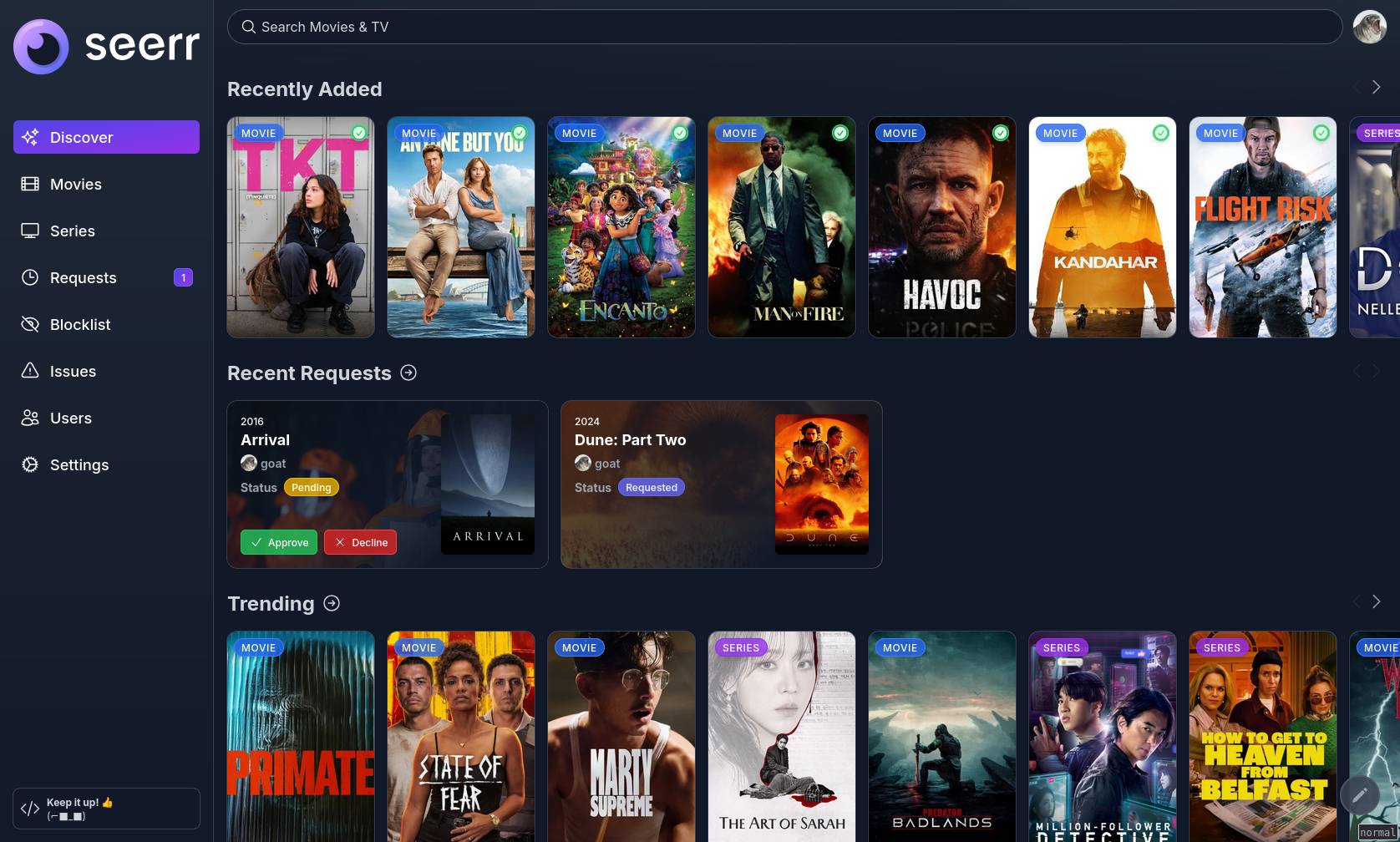
Unified media request management (Plex, Jellyfin, Emby) on FreeBSD.
Before deploying, ensure your host environment is ready. See the Quick Start Guide for host setup instructions, including the security model for host vs. container privileges.
Deployment
Database Where the app keeps its data. The default needs nothing else running.
SQLite PostgreSQL Your own
seerr:latest — data in /path/to/containers /seerr
A file in the app's config folder. Right for one person, nothing extra to run.
1. Save as .env and fill in what is empty:
2. Save as compose.yaml:
name : seerr
services :
seerr :
image : ghcr.io/daemonless/seerr:latest
container_name : seerr
restart : unless-stopped
environment :
- PUID=1000
- PGID=1000
- TZ=UTC
- DB_TYPE=${DB_TYPE:-sqlite}
- DB_HOST=${DB_HOST:-}
- DB_PORT=${DB_PORT:-5432}
- DB_USER=${DB_USER:-}
- DB_PASS=${DB_PASS:-}
- DB_NAME=${DB_NAME:-}
volumes :
- /path/to/containers /seerr:/config
ports :
- 5055:5055
Then run podman-compose up -d.
seerr:latest · postgres:17 — data in /path/to/containers /seerr, /containers /seerr/postgres
One more container, its data in its own folder. For a household, or an app that wants it.
1. Save as .env and fill in what is empty:
/containers /seerr/postgres
2. Save as compose.yaml:
name : seerr
services :
seerr :
depends_on : [ postgres ]
image : ghcr.io/daemonless/seerr:latest
container_name : seerr
restart : unless-stopped
environment :
- PUID=1000
- PGID=1000
- TZ=UTC
- DB_TYPE=${DB_TYPE:-sqlite}
- DB_HOST=${DB_HOST:-}
- DB_PORT=${DB_PORT:-5432}
- DB_USER=${DB_USER:-}
- DB_PASS=${DB_PASS:-}
- DB_NAME=${DB_NAME:-}
volumes :
- /path/to/containers /seerr:/config
ports :
- 5055:5055
postgres :
image : ghcr.io/daemonless/postgres:17
restart : always
annotations :
org.freebsd.jail.allow.sysvipc : "true"
environment :
- POSTGRES_USER=${DB_USER}
- POSTGRES_PASSWORD=${DB_PASS}
- POSTGRES_DB=${DB_NAME}
volumes :
- "${DATABASE_LOCATION}:/var/lib/postgresql/data"
Then run podman-compose up -d.
seerr:latest · your own database — data in /path/to/containers /seerr
A database you already run, here or on another machine. Nothing extra runs; you give the address and the account.
1. Save as .env and fill in Kind, Host, Port, User, Password, Database:
2. Save as compose.yaml:
name : seerr
services :
seerr :
image : ghcr.io/daemonless/seerr:latest
container_name : seerr
restart : unless-stopped
environment :
- PUID=1000
- PGID=1000
- TZ=UTC
- DB_TYPE=${DB_TYPE:-sqlite}
- DB_HOST=${DB_HOST:-}
- DB_PORT=${DB_PORT:-5432}
- DB_USER=${DB_USER:-}
- DB_PASS=${DB_PASS:-}
- DB_NAME=${DB_NAME:-}
volumes :
- /path/to/containers /seerr:/config
ports :
- 5055:5055
Then run podman-compose up -d.
Database Where the app keeps its data. The default needs nothing else running.
SQLite PostgreSQL Your own
seerr:latest — data in /path/to/containers /seerr
A file in the app's config folder. Right for one person, nothing extra to run.
1000
1000
UTC
# appjail-director.yml
options :
- virtualnet : ':<random> default'
- nat :
services :
seerr :
name : seerr
options :
- container : 'args:--pull'
- expose : '5055 :5055 proto:tcp'
oci :
user : root
environment :
- PUID : !ENV '${PUID}'
- PGID : !ENV '${PGID}'
- TZ : !ENV '${TZ}'
- DB_TYPE : !ENV '${DB_TYPE}'
- DB_HOST : !ENV '${DB_HOST}'
- DB_PORT : !ENV '${DB_PORT}'
- DB_USER : !ENV '${DB_USER}'
- DB_PASS : !ENV '${DB_PASS}'
- DB_NAME : !ENV '${DB_NAME}'
volumes :
- SEERR_CONFIG_PATH : /config
volumes :
SEERR_CONFIG_PATH :
device : '/containers /seerr '
ghcr.io/daemonless /seerr:${tag}
Save the files above, then run appjail-director up.
seerr:latest · postgres:17 — data in /path/to/containers /seerr, /containers /seerr/postgres
One more container, its data in its own folder. For a household, or an app that wants it.
1000
1000
UTC
# appjail-director.yml
options :
- virtualnet : ':<random> default'
- nat :
services :
seerr :
name : seerr
options :
- container : 'args:--pull'
- expose : '5055 :5055 proto:tcp'
oci :
user : root
environment :
- PUID : !ENV '${PUID}'
- PGID : !ENV '${PGID}'
- TZ : !ENV '${TZ}'
- DB_TYPE : !ENV '${DB_TYPE}'
- DB_HOST : !ENV '${DB_HOST}'
- DB_PORT : !ENV '${DB_PORT}'
- DB_USER : !ENV '${DB_USER}'
- DB_PASS : !ENV '${DB_PASS}'
- DB_NAME : !ENV '${DB_NAME}'
volumes :
- SEERR_CONFIG_PATH : /config
seerr-postgres :
name : seerr_postgres
priority : 10
options :
- from : ghcr.io/daemonless/postgres:17
- template : !ENV '${PWD}/postgres-template.conf'
oci :
environment :
- POSTGRES_USER : !ENV '${DB_USER}'
- POSTGRES_PASSWORD : !ENV '${DB_PASS}'
- POSTGRES_DB : !ENV '${DB_NAME}'
volumes :
- database : /var/lib/postgresql/data
volumes :
SEERR_CONFIG_PATH :
device : '/containers /seerr '
database :
device : !ENV '${DATABASE_LOCATION}'
ghcr.io/daemonless /seerr:${tag}
Save the files above, then run appjail-director up.
seerr:latest · your own database — data in /path/to/containers /seerr
A database you already run, here or on another machine. Nothing extra runs; you give the address and the account.
1000
1000
UTC
# appjail-director.yml
options :
- virtualnet : ':<random> default'
- nat :
services :
seerr :
name : seerr
options :
- container : 'args:--pull'
- expose : '5055 :5055 proto:tcp'
oci :
user : root
environment :
- PUID : !ENV '${PUID}'
- PGID : !ENV '${PGID}'
- TZ : !ENV '${TZ}'
- DB_TYPE : !ENV '${DB_TYPE}'
- DB_HOST : !ENV '${DB_HOST}'
- DB_PORT : !ENV '${DB_PORT}'
- DB_USER : !ENV '${DB_USER}'
- DB_PASS : !ENV '${DB_PASS}'
- DB_NAME : !ENV '${DB_NAME}'
volumes :
- SEERR_CONFIG_PATH : /config
volumes :
SEERR_CONFIG_PATH :
device : '/containers /seerr '
ghcr.io/daemonless /seerr:${tag}
Save the files above, then run appjail-director up.
Access at: http://localhost:5055
Interactive Configuration
Parameters
Environment Variables
Variable
Default
Description
PUID1000User ID for the application process
PGID1000Group ID for the application process
TZUTCTimezone for the container
DB_TYPEsqlitesqlite or postgres; set by the Database choice
DB_HOST``
PostgreSQL host (Database choice)
DB_PORT5432PostgreSQL port (Database choice)
DB_USER``
PostgreSQL user (Database choice)
DB_PASS<DB_PASS>PostgreSQL password (Database choice)
DB_NAME``
PostgreSQL database name (Database choice)
Volumes
Path
Description
/configConfiguration and database directory
Ports
Port
Protocol
Description
5055TCP
Web UI
Implementation Details
Architectures: amd64, aarch64User: bsd (UID/GID set via PUID/PGID ). Defaults to 1000:1000.Base: Built on ghcr.io/daemonless /base
Need help? Join our Discord community.
 Seerr
Seerr